Home · Specifications & Install
Specifications

Five sizes.
Two constructions.

Units are built in PVC and steel, in the same size range and with the same internal geometry. Size to your flow, not your acreage — the acreage column is a planning figure for typical row-crop duty, not a limit.

140 PSI max operating 500–4,400 GPM 4″–12″ flanged both ends 0 moving parts 10 yr warranty
CONSTRUCTION A

PVC — Schedule 80

The documented range below. Schedule 80 PVC pipe and fittings, 140 PSI maximum operating pressure, flanged ends in PVC or mild steel. Lighter to handle and support — the usual choice where it mates to PVC inside the system's normal pressure envelope.

CONSTRUCTION B

Steel

The same size range for lines where PVC is not the right body — steel mains, higher-duty or exposed installations, and sites where mechanical robustness matters more than weight. Dimensions, weights and pressure rating differ from the PVC range; request the steel data sheet when specifying.

PVC Schedule 80 range
Pipe sizeOverall lengthFlange ODConstruction Max pressureMax flowWeightAcres covered
4″39.0″8.0″PVC Sch 80140 PSI500 GPM55 lb25
6″30.5″10.0″PVC Sch 80140 PSI1,100 GPM78 lb50
8″30.5″12.0″PVC Sch 80140 PSI2,100 GPM123 lb90
10″38.5″16.0″PVC Sch 80140 PSI3,200 GPM211 lb150
12″43.3″19.0″PVC Sch 80140 PSI4,400 GPM241 lb225

Note the 4″ unit is the longest in the range at 39.0″ — the 6″ and 8″ bodies are shorter. Check your available straight run against overall length before ordering, not against nominal pipe size. Flanged ends are available in PVC or mild steel; specify at order so the bolt pattern matches what you are mating to.

Installation

Where it goes,
and which way it faces.

One rule governs placement: every drop you want treated has to pass through the unit, and it goes downstream of filtration. Mainline for the whole ranch, submain or block head for one field, pump discharge or greenhouse header for a station. Installation is referred to a certified installer.

Sourcewell / CAP / reclaimedPumpexistingFilterexistingMeterflow, in-lineVORTERRA4″–12″ inline spoolManifold → lateralsunchanged FLOW → Soil-moisture sensors root zone · verifies the saving Everything upstream and downstream stays exactly as built.

One common arrangement, not the only one. Here the unit treats everything past a single filter station — a whole-ranch install. On a multi-block system it just as often sits on a submain or at a block head; the sequence relative to pump and filtration is what stays fixed. Soil-moisture instrumentation is optional for the unit, but it is what turns "we think it's working" into a number.
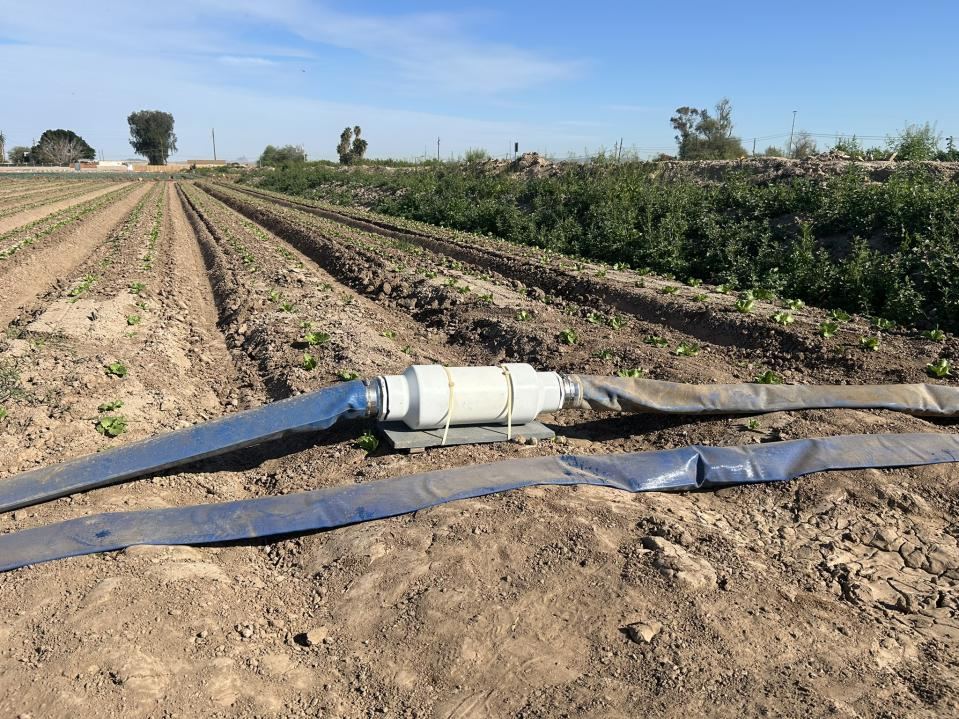
Vorterra unit installed inline at the University of Arizona K3 trial field
As installed at the University of Arizona trial. Inline on the supply line, downstream of filtration — every drop through the unit.
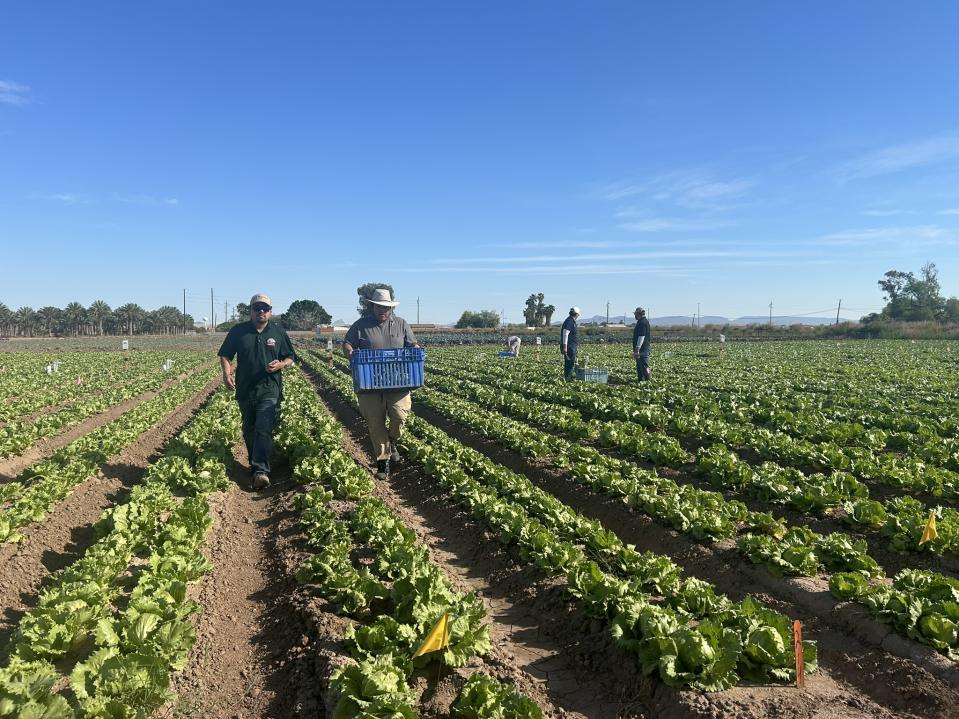
Harvest at the K3 field trial
What it's there for. Harvest at the same field, March 2026 — +20.5% yield in the best treatment.
WHOLE RANCH

Mainline

One unit past the source and filter station treats everything downstream of it.

ONE FIELD

Submain or block head

Treats that block only — the arrangement you want for a demo-versus-control trial.

STATION

Pump discharge

On the discharge side, downstream of filtration, where a station serves a defined area.

PROTECTED

Greenhouse or CEA header

On the header feeding the house, sized to that flow rather than field acreage.

01

Size to flow, then check the length

Pick the size from your design flow against the max-flow column. Then measure the straight run you can free up against overall length — the 4″ unit needs 39″ of clear pipe.

02

Locate by what you want treated

Work backwards from the ground. Wherever you land, it goes downstream of the pump and of any sand separator, screen or disc filtration — it is not a filter, and upstream placement only exposes it to debris.

03

Fit isolation valves and a flow meter

Valve either side so the unit can be isolated without shutting the block down; meter immediately upstream to confirm flow rating and run the pilot.

04

Mount horizontally wherever possible

Horizontal is the preferred orientation. If vertical is unavoidable, water enters at the top and flows downward — a vertical unit plumbed to flow upward is installed wrong.

05

Support the body, bolt up square, commission at pressure

Saddles or a pad carry the weight — not the flange bolts. Full-face gasket, star-pattern torque to the flange manufacturer's figure, flush before final connection, then bring the system up slowly and record baseline flow and pressure both sides.

Refer to a certified installer

Vorterra's product documentation specifies that installation be referred to a certified installer. The steps above describe the work so you can scope and inspect it — they are not a substitute for that requirement, your local code, or your flange manufacturer's torque specification.

Straight answers

The questions irrigation
people actually ask.

What head loss should I design for?
Treat it as the loss of a spool of that diameter and length with internal geometry — it adds no pressure and it is not free. Record pressure upstream and downstream at commissioning, and confirm you are inside the 140 PSI maximum across the whole duty cycle, including water hammer on valve closure.
Does it work on flood or furrow?
The unit needs a pressurized, closed line to sit in. The addressable case is pressurized irrigation — sprinkler, pivot, linear, solid-set, drip and micro.
What about reclaimed or high-salinity water?
Multi-season commercial results on strawberries were produced on reclaimed tertiary-treated municipal water, so reclaimed supply is within normal use. It is not a treatment step: it does not change salinity, SAR or nutrient load, and a leaching fraction is still a leaching fraction.
PVC or steel — which one do I order?
Both run the same internal geometry, so the treatment is identical. Pick on the body: PVC where you tie into PVC inside its pressure envelope — far lighter to lift and support. Steel where you mate to steel or the duty is harder on the body. Ask for the steel data sheet before committing to a size — its dimensions, weights and rating differ.
Does it have to go on the mainline?
No — that is the most common photograph, not the rule. Only water passing through the unit is treated, and it belongs downstream of filtration. Mainline treats everything; a submain or block head treats one field; a pump discharge or greenhouse header treats what that station serves.
Will it clog?
There is no screen, membrane or orifice to blind off — it is an open bore with internal geometry. It still sits downstream of your filtration, and it will not rescue a system under-filtered for its emitters.
How long before I see anything?
Infiltration behaviour changes as soon as treated water reaches the ground. Yield and water-productivity effects are measured over a season — the Arizona trial ran a full 97-day crop. Product literature cites potential cost recovery in as little as six months; treat that as a claim to test against your own metered result.
Do I own it or lease it?
Units are leased, not purchased. Vorterra retains title, calibration and service, so you carry no equipment risk or depreciation. Product literature cites a 10-year warranty and, for first-time customers, a 1-year full-satisfaction money-back guarantee.
What is the sensor requirement?
None, for the unit to function. But the University of Arizona's own recommendation is to pair it with real-time root-zone monitoring — the operational gain of safely skipping an irrigation depends on confirming root-zone moisture before you skip.
Sizing a line?

Send us your flow and pipe size —
we'll spec the unit.