The unit does one thing: it converts axial flow into a tight, sustained vortex, then lets that vortex collapse. Everything downstream follows from that — and every part of it can be drawn, instrumented and argued with.
Section along the flow axis. The internal geometry is fixed — the water moves, the unit does not. As swirl builds, the radial pressure gradient drops static pressure at the core; where it falls below the local vapour pressure, vapour cavities form. Those cavities collapse as pressure recovers downstream of the throat, which is where the energy is delivered back into the water.
Water arrives the way your mainline delivers it — straight, pressurized, with a flat velocity profile across the bore. Nothing has happened to it yet.
Internal flow tubes turn axial momentum into tangential momentum. The flow rotates and converges toward the axis; angular velocity rises as radius falls.
Rotation sets up a radial pressure gradient — pressure falls toward the centre of rotation, and in the throat vapour cavities nucleate along the core.
Past the throat the section opens, pressure recovers, and the cavities collapse — brief, intense, local, and repeated on every drop that passes through.
This category is often sold with molecular language — "breaking water clusters," "resonance," "restructuring." We lead with the mechanism that can be drawn and instrumented: swirl, a radial pressure gradient, cavitation and collapse. What matters on your farm is not the vocabulary but whether the wetting front and the yield move — which is what the trial data measures.
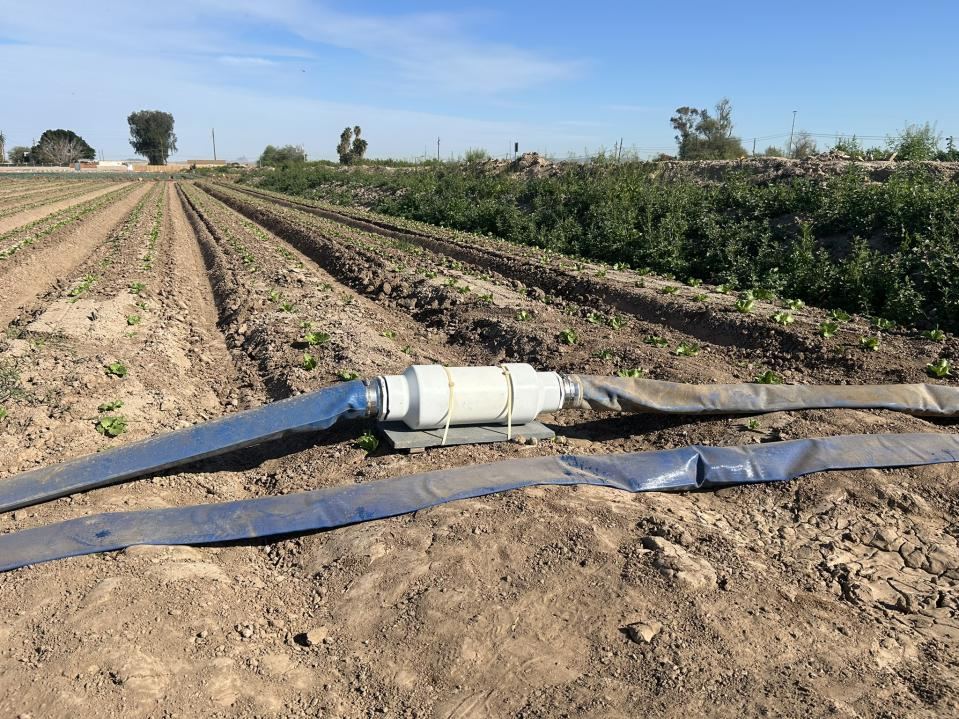
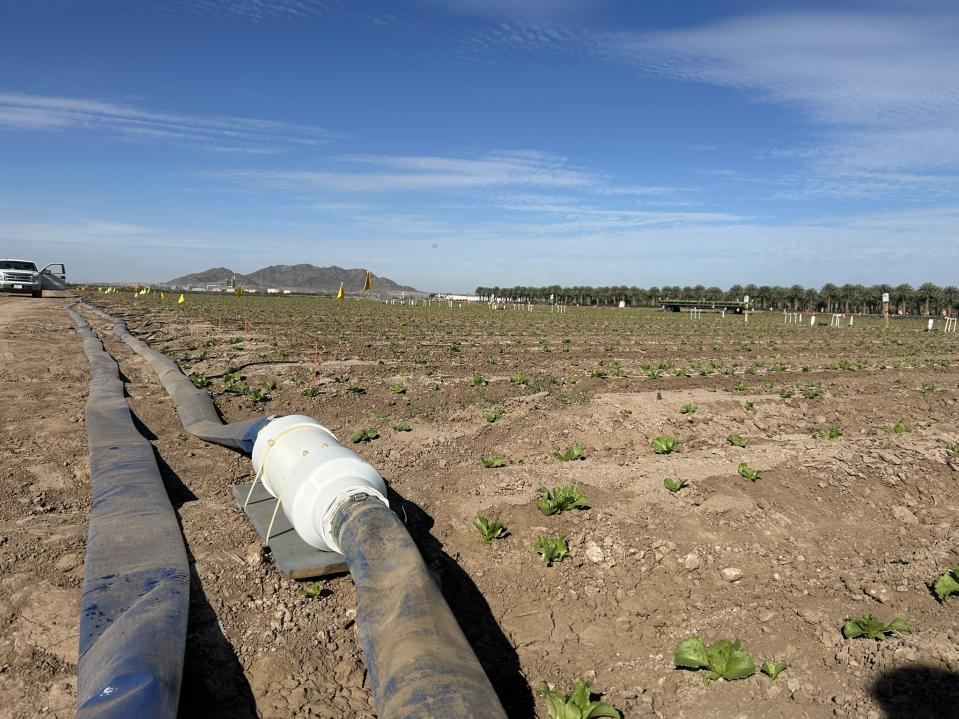
From the University of Arizona's evaluation report — the unit installed inline on the K3 Field supply line at the Yuma Agricultural Center, where every drop of irrigation water passed through it for a 97-day iceberg lettuce season.
Treated water shows lower surface tension. On the ground that reads as better contact between water and soil: it wets in rather than beading and sheeting, moves further laterally off an emitter, and carries dissolved nutrient with it instead of leaving a concentrated ring at the surface.
The unit does not reduce your water use on its own. It changes what a given volume does in the soil; the saving comes from the operator dialling the set back. The pilot protocol exists precisely to find out — defensibly — how far you can turn it down before the crop tells you to stop.
Water that wets in instead of sheeting reaches deeper into the profile, and roots follow it down.
Dissolved nutrient travels with the wetting front rather than concentrating at the surface — the trial held yield at −27% N.
Operators report cleaner emitters and internal surfaces over time — less maintenance on the far end of the system.
Moisture holding longer between events is what lets an operation skip irrigations and ride out allocation cuts.